4/21/13

Nam Tae Hi

Nam Tae Hi
Rhee Ki Ha

Born in Seoul, South Korea in March 1929, Great Grandmaster Nam Tae Hi met General Choi on Cheju Island in 1953 and later joined the 29th Infantry Division of the South Korean military forces. Great Grandmaster Nam Tae Hi, then a captain in rank, was a senior member of the demonstration team which gave the seminal performance in 1954 before South Korean President Seung Man Rhee which led to the presidential decree that the martial art (then not yet known as Taekwon-Do) be a mandatory part of training for the military. Great Grandmaster Nam Tae Hi then co-founded with General Choi Hong HI the Oh Do Kwan, the training gym for the military where he had the role of Chief Instructor. At the Chung Do Kwan (training gym for civilians), GGM Nam Tae Hi taught Jhoon Rhee, recognized in the United States as the "Father of Taekwon-Do," when Jhoon Rhee was a first degree black belt. Great Grandmaster Nam Tae Hi served as one of the earliest ambassadors of Taewkon-do when in March 1959 he traveled to Vietnam and Taiwan as member of the first Korean demonstration team to travel outside of Korea. In December 1962, GGM Nam Tae Hi was assigned as Chief Instructor for the Vietnamese Army. In Vietnam, GGM Nam Tae Hi is known as the "Father of Taekwon-Do." He developed the patterns known as Hwa-Rang, Choong-Moo, and UI-Ji. GGM Nam Tae Hi served as vice-president of the International Taekwon-Do Federation and president of the Asian Taekwon-Do Federation. Great Grandmaster Nam Tae Hi moved to Chicago in 1972, opened a dojang in 1973, and taught Taekwon-Do for twenty years. He now calls Los Angeles home where he lives with his wife.

Grand Master Nam Tae Hi began his martial arts training in 1946. Every day after school he would go to the Dojang to train, not returning home until almost midnight. He did this 5 days a week. He trained in Tang Soo Do under Won Kuk lee at the Chung Do Kwan. His fellow students included Sun Duc Son, and Uhm Woon Kyu. After about two and one half years Nam Tae Hi reached the level of first degree Black Belt. Two of his junior students included the late Grandmaster Han Cha Kyo, and Grand Master Jhoon Rhee. In 1954 there was a military demonstration before the President of South Korea, Syng Man Rhee. This demonstration included Artillery, other weaponry and martial arts. Nam Tae Hi, now a second degree Black Belt, broke 13 roofing tiles using a downward punch. President Rhee was so impressed by this demonstration that he asked to see more after the planned program was over. Nam Tae Hi and Han Cha Kyo did not have any thing else arranged to do so they assembled materials and did a variety of different breaks. President Rhee even checked Nam Tae Hi’s hands to see if he was injured from performing the breaks. After the demonstration President Rhee ordered all military personnel to start training in this martial art. General Choi drafted instructors from a number of different Kwans to teach the soldiers. Nam Tae Hi was the person who peformed the patterns as General Choi created them. The General would suggest a move or two and after Nam Tae Hi performed them, the general would either accept the moves or offer changes. Nam Tae Hi himself contributed the patterns Hwa-Rang, Choong-Moo and Ul-Ji. He was often referred to as the General's right hand man. Without Nam Tae Hi's incredible performance at the demonstration for President Rhee, Taekwon-Do may not have had the opportunity to spread around the world as we have seen it do.
Zavřít okno

2/2/13

3 Methods for Learning Martial Arts Techniques More Efficiently

3 Methods for Learning Martial Arts Techniques More Efficiently

3 Methods for Learning Martial Arts More Efficiently“Practice makes perfect”, or so we were led to believe when we were growing up. “If you do something 10,000 times, you’ll be a master,” is another similar saying. But this isn’t the whole story. That’s why my Sensei always said, “Practice does NOT make perfect; perfect practice makes perfect. Practice makes permanent.” In other words, if you practice a thing 10,000 times wrongly you’ll have only mastered doing that thing wrong, sealing the incorrect method into your muscle memory.
This is why it’s important to train your body to do a physical skill like a martial arts technique correctly as quickly as possible so that all your practice serves to reinforce that method, rather than reinforcing a method that is incorrect or inefficient, even if it feels more natural to you. There are methods of correcting technique to get yourself on track more quickly an efficiently, three of which I will outline in this article.
When You Make a Mistake, Over-Compensate
If you make a mistake, the worst thing you can do immediately after is to repeat exactly the same mistake. Doing this reinforces the incorrect method. most people will aim to do correct the mistake by aiming for the perfect method, but more times than not, it leads to making the same mistake but to a lesser extreme. This is better than exact repetition of the error, but it will tend to take more repetitions of aiming for perfection to make the necessary incremental adjustments to achieve it. This is because our bodies tend to want to default to the methods that feel natural to our bodies even if we know they are wrong in our minds.
To correct for this more efficiently, you’re better off over-compensating incorrectly to the opposite extreme. If you’re keeping your guard too low when you spar, bring them up to a position that’s too high on your next attempt. If your aim of a punch to solar plexus is landing too far to the right, aim to land too far to the left. Over-compensating to the opposite extreme will train your body to work outside what feels natural,  helping it to correct more quickly and efficiently to the median of accurate placement.
To Learn Faster, Go Slower
When training at higher speeds, as we tend to want to do in the martial arts, it’s harder for you to detect your own errors. Your brain doesn’t have time to perceive the mistakes, whether it’s what’s you see or the way it feels in your body. When you practice a technique slowly, you’ll more easily notice incorrect hand position when doing a wrist lock or foot work when doing a takedown. This is one of the reasons why I encourage students to practice new or problematic techniques slowly without power, so they can be more aware of any errors and self-correct as necessary. Sometimes we’ll even use super-slow motion training for even higher levels if awareness. This can be great for times when you’re really struggling with a technique. Here is a blog post I wrote related to the topic of reducing speed when doing martial arts training.
Focus on a Strong Start and Finish
Sometimes slow motion training is impractical, like when you’re working on throws, jumping kicks, flying arm bars, etc. In these situations, you can instead focus on having a strong beginning position and ending position.
For a shoulder throw, you enter the throw with your feet shoulder-width apart, hips well below those of your training partner with your arms breaking their balance from their shoulder straight forward. Once your partner’s heels are lifted you can then follow through with the rest of the movement of the throw. A strong finishing position should be on balance with feet firmly in place with the body coming upright as your training partner hits the ground right in front of you. If their breakfall is on form, their legs should be pointing away from you. If your ending position is a little off the mark, correct it after the fact to train your body to be where you want it to be. By training a strong start and finish for any technique, the steps in between are more likely to correct themselves on the move in order to connect the mental dots you have established in your mind and body.
Combining Learning Methods
Sometimes I’ll run a class specifically focusing on one of the above approaches to learning depending on what my students are working on. But you don’t need an instructor to specifically direct you to use these methods in your training. I encourage my students to use these methods based on their own training needs. If they can learn to be their own teacher to some degree, thanks to sound training methods, they won’t always need to wait for an instructor’s attention to get the corrections they need. Of course, these methods won’t solve every problem and you still need an instructor’s expertise and objective eye to make subtle improvements and catch subtle errors, as you become better at what you do.
If you’d like to read more about these concepts, check out chapter 7 of Dan Millman’s Body Mind Mastery: Creating Success in Sport and Life.
Do you or your instructor have other ways of helping learn skills more efficiently? Please feel free to share them in the comments.

1/30/13

Master Alexandris Taekwon-do ITF 8 dan, Ground Kicks


There are a selection of kicks that can be used from the ground. . Many of the kicking techniques can be added to rolls and breakfalls... for the situation of going down and having to defend yourself when you don't have the opportunity to get back to your feet for whatever reason. Master Alexandris Taekwon-do ITF 8 dan, shows few of them


12/16/12

Why do we Kiap?

from http://www.kidokwan.org/articles/why/why-do-we-kiap-%EA%B8%B0%ED%95%A9%E6%B0%A3%E5%90%88/

Why do we Kiap?

Why do we kiap? Kiaps are nothing new to Korean or Japanese martial arts. In Japanese it is called Kiai (??). The reasons behind Kiaps varies from organization, styles and even schools. There are many ways or sounds of the Kiap/Kiai. They range from a ‘grunt to a
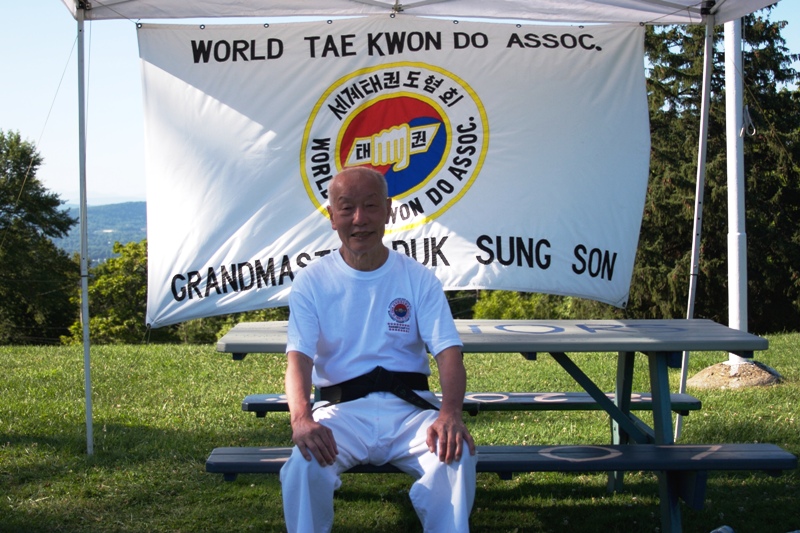
Grand Master Duk Sung Son
loud yell or other sounds and some even yell “kiai” etc. Grandmaster Son, Duk-sung of the World Taekwondo Association/ChungDo Kwan was known for shouting “utz” and promoted it in his publications.
Of course, the Korean concept comes directly from the Japanese influences as Japan had a huge influence in the development of modern Korean martial as from Taekwon-Do (???/??? ) and Hapkido (???/???) and is used exstevicely in Kumdo/Kendo (?? ??) too . A Kiap/Kiai is essentially a “war cry” and every society and military has different versions of it. We have seen it in all sorts of movies from Mel Gibson’s “Braveheart” and “We were Soldiers” to movies like the “Last Samurai” and “TaeKukk Ki.”
Korean Karate Cover, Grandmaster Son
It is a pretty known fact that with proper timing the actual act of a Kiap at the time of the execution of the techniques, it helps generate power. Partly because of the physics involved.
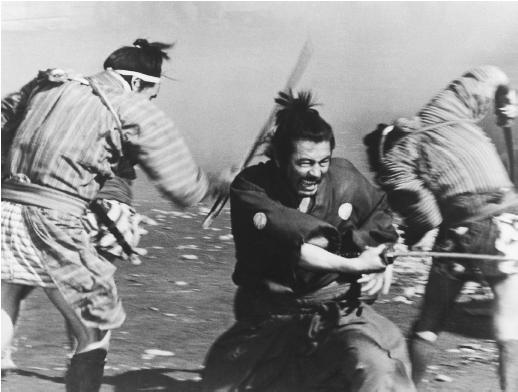
Yojimbo Movie
Yojimbo Movie
The two terms “kiap” and “kiai” are the same as “Hapki” (hapkido) and “Aiki” (Aikido) but transposed. The terms basically mean “coordination spirit/united spirit”. Some styles and organizations promote it more as a meta-physical aspect of martial arts, but others more as a practical application at the time of the execution of techniques. Try any technique on a target. The first one take a breath and hold it and execute your technique (doesn’t really matter what technique you use) and then use the exact same technique but this time do a kiap/kiai at the time of the technique you will clearly feel and see the difference.
(As a side note:  The I.T.F. have never any kiap used in them.   General Choi never wanted then incorporated, it was only I.T.F. instructors, from the older Kwans that put them in.  E.G. GM Jhoon Rhee, GM Cho, Hee-il etc.  Only in the last couple of years has the I.T.F. under Choi, Jung-hwa put them in the tuls/patterns.)

11/7/12

Ethics of Muaythai Warrior

Ethics of Muaythai Warrior


1. Make oneself useful to the public.
2. Be polite to everybody wherever possible.
3. Do not show violent behavior.
4. Be faithful to oneself and others.
5. Show perseverance.
6. Be willing to sacrifice oneself for the good of your country.
7. Be strong willed and resolute in your mind
“As strong as steel, as hard as diamond”

8. Hold high morality. (Be a gentleman/woman)
9. Be respectful of your own and your camp name. Never to bring these
into ill repute.
10. Exercise and train hard regularly.
11. Do not take advantage of your opponent by infringement of rules.
12. Do not take any kind of illegal or harmful drugs or substances.

‘Always respect and abide by the law of the land’
Chinawut sirisompan ( Grand Master Woody)

Chairman of Kru Muaythai Association

11/2/12

Alex Gillis Discusses Tae Kwon Do and “A Killing Art” with Kung Fu Tea.


Alex Gillis Discusses Tae Kwon Do and “A Killing Art” with Kung Fu Tea.


Alex Gillis, author of A Killing Art.
Welcome of the Halloween 2012 edition of Kung Fu Tea!  A few weeks ago I had the chance to review Alex Gillis’ groundbreaking work on the origins and development of Tae Kwon Do, A Killing Art.  Click on the links to see that post or the book.  This detailed study is a wonderful example of martial arts history and the sort of thing that I think we need to see more of in the field of martial studies.
I also had the opportunity to exchange emails with Alex and found him to be friendly and open.  He clearly has a passion for his subject and is immensely knowledgeable.  He agreed to drop by Kung Fu Tea and answer some questions about the process of writing this sort of history and the reception that the book has received.
oOo
Kung Fu Tea (KFT): How have Tae Kwon Do practitioners, both in Korea and the rest of the world, received your book?  Has it received a generally positive reception?  Has it affected your relationships with other individuals in Tae Kwon Do community?
Alex Gillis (AG): Hundreds of people have sent me notes over the past four years, all of them positive about the English, Spanish and German books. I haven’t counted, but I estimate I received nearly 1,000 emails. Also, during book signings in the US, UK, Canada and Germany, I’ve spoken to thousands of people, and almost all the feedback has been positive — overwhelmingly so.
There have been negative comments, I’ve heard, on blogs, but most of them have been anonymous. I haven’t looked up the chat groups, listservs and blogs where I’m getting anonymously slagged, but I’m sure they’re out there somewhere. What I find incredible is that the major international Tae Kwon Do organizations, especially in South Korea, have ignored my book, but their instructors and masters (and some grandmasters) have contacted me individually, almost as if they were doing something wrong in talking to me.
The support has been over-the-top positive, because people have been gossiping for decades, so many people knew parts of the true history, but A Killing Art brings together different strands of the history, which, I now realize, readers appreciate. I put seven years of work into the book, ensuring that I got facts right, and I footnoted heavily, because I knew readers would say, “What the hell?! How does he know that?”

A fallen monument in the Goodleberg Town Cemetery, Wales NY. Photo Credit: Benjamin Judkins, September 2012.
KFT: What was the most challenging aspect of researching a project like this? Was it difficult to get your sources to agree to give “on the record” interviews about such challenging topics?
AG: The most challenging part of the research was finding solid proof that secret-service agents (those who worked for or with the Korean Central Intelligence Agency and North Korean secret service) were helping to run Tae Kwon Do federations, and that the agents/instructors collaborated with the South and North Korean dictatorships during different decades. Also challenging was figuring out what the founders added to the art as opposed to simply stole from Karate or Taekkyeon (an old Korean martial art).
It was difficult to get on-the-record interviews on these topic and others, but many masters and instructors participated when they realized that I knew a lot about the history. Interviews rise to a different level when interviewees know that one-liners or the “party line” won’t work. So, for example, telling a journalist that Tae Kwon Do is 2,000 years old might fly with a local newspaper reporter who doesn’t have time to check facts, but it didn’t work on me, as I knew the truth from background research. Tae Kwon Do is only 50 or 60 years old, and it developed mainly from Japanese Karate. However, if you type “Taekwondo” in Wikipedia or Google, you’ll find sites that state or imply that it’s hundreds or thousands of years old and that contain all sorts of drivel about ancient dynasties and hwarang warriors. I’m empowered by the fact that well known war heroes and super-athletes developed my martial art, not flowery unnamed warriors.
KFT: You have a background both as an investigative journalist and as a university instructor.  Do you think that this book would have looked substantially different if you had been a pure historian?  What skills did journalism allow you to bring to table that might be missing in more “academic” writing on the martial arts?
AG: Perhaps the book would have been different if a historian had tackled the topic — perhaps a historian would have made it more abstract and less concrete and dramatic. Depends on the historian! I’ve read dramatic, concrete histories. My skills as an investigative journalist allowed me to ask the right questions and to delve into topics that were deeper than those asked by news journalists. Also, with all my research and interviews, I pushed myself to find engaging ways to present the facts and tell people’s stories — with storytelling that would go beyond lists of facts. Basically, I added heart and emotions where I could.
Presenting General Choi Hong-Hi’s life is an example. He was a complex person (as most of us are), and I wanted to show why people thought he was a genius and a dictator, a generous man and a selfish one, too — all at the same time. He seemed to be a megalomaniac and an extremely aggressive leader, but he had to seem that way when facing down homicidal dictators and rogue secret-service agents who wanted to kidnap him and his pioneers. I have a lot of respect for him (but not for all of his actions). While presenting people like that in my book, I felt I had to stick to the facts while adding complex emotions and context.

Barbed wire hanging from an oak tree. Conewango Valley, NY. Photo Credit: Benjamin Judkins, September 2012.
KFT: When I was reading Chapter 19 of your book (“Reprieve”) I could not help but be struck by the contrast between what you had written about, and what you and your daughter actually experienced in your neighborhood Tae Kwon Do school.  Has there always been this disconnect between what was happening at the top of the sport and at the bottom?  It seems hard to imagine that the chaos you describe in the 1980s and 1990s didn’t deeply affect the lives and careers of many aspiring martial artists.
AG: Yes, there has always been a disconnect between what happens at the top of a sport or martial art and what happens among instructors and students. From what I know, this occurs in many sports. Look at soccer and FIFA for instance! Tae Kwon Do practitioners typically had and have no idea how much corruption and cheating occurred in the Olympics for instance. When coaches and athletes did discover the levels of cheating, many had to keep quiet in order to compete, hoping that they wouldn’t be the next victims of “branch trimming,” which was the sophisticated cheating-system that ensured the strongest fighters got eliminated in opening rounds at the Olympics. Careers and lives were deeply affected.
KFT: It has been about four years since your book first came out.  How are things looking in the Tae Kwon Do world today? Have the governing bodies of the sport in Korea and abroad managed to clean up their act and live up to their promises for reform? Is the sport growing and healthy?
AG: There has been a lot of promise about cleaning up their acts — being transparent and fair — but I’m not certain that the governing bodies have lived up to their promises. I keep hoping.
KFT: What are the biggest trends you are seeing in the Korean martial arts today outside of the world of Tae Kwon Do?
AG: The unacknowledged Tae Kwon Do backgrounds of fighters in the MMA, UFC and other popular sports.
KFT: Yes, I can see how that might be frustrating to a lot of individuals within the Tae Kwon Do community.  Thanks so much for taking the time to stop by!
Pumpkin Still Life. Photo Credit: Benjamin Judkins

10/10/12

Muay boran

Muay boran (Thai: มวยโบราณ, RTGS: muay boran, IPA: [mūɛj bōːrāːn], lit. "ancient boxing") is an umbrella term for the unarmed martial arts of Thailand prior to the introduction of modern equipment and rules in the 1930s. It is thus the direct ancestor of modern Muay Thai.[1] The word muay which means "boxing" comes from the Sanskrit term mavya meaning to bind together.[citation needed] Boran or boraan means "ancient" in Thai.[citation needed]
Muay boran is not a single style but acts as an umbrella term for all traditional Thai styles of Indochinese kickboxing. Whereas Muay Thai is often called the "science of eight limbs", muay boran is said to make use of nawa awut which means "nine weapons", adding headbutts as ninth offensive in addition to the "eight limbs" of hands, legs, elbows and knees used in Muay Thai.